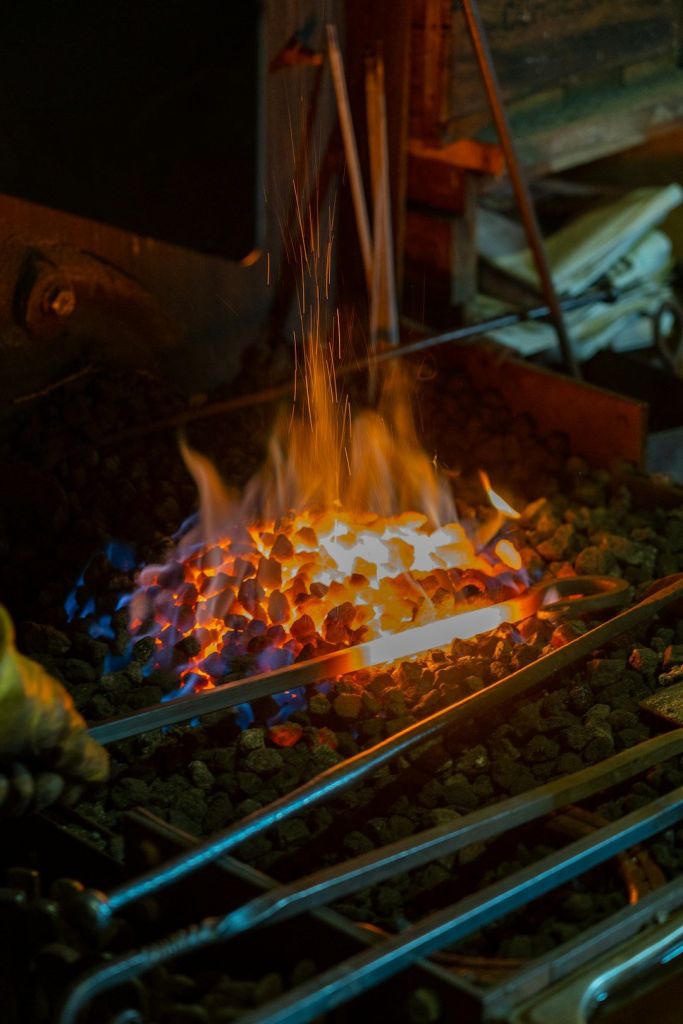
What would the world be like without fire? With it we cook our food, heat our houses, fly in airplanes, and drive our cars. Just imagine trying to bake bread without heat or only eating raw meat—or there being no heat or light. Without the creation of fire, we would live in a vastly different world indeed. Many of us may have no idea what and where we rely on fire, or a form of it, in our daily lives.
Most of the ladies in our homes do not use wood fired ovens in their kitchens like they used to, but the heating element in their ovens is sort of like a controlled electrical short, in an environment that does not have combustible material to burst into flame. This is also similar to a light bulb which we rely on to give us light.
Aside from putting fuel in the tank, we give little thought as to what makes our car motor down the road. A pump pushes the fuel from the tank to the motor. There the fuel mixes with the air going into the engine. It is put under high pressure and in a gasoline engine, a spark ignites it into flame, making an explosion, creating more pressure and expansion. The pressure drives the piston down with an explosion of heat and force, turning the crank. This is done in rapid succession with multiple pistons which create horsepower. The crank turns the transmission, which turns the wheels, making our car roll down the road. We do not even think of it that fire is making our vehicles go.
In bygone years they used actual coal or wood to heat water which created steam. The steam then drove the turbine or pistons which produces power. This was dangerous, it took a lot of heat, and steam creates a lot of pressure, and sometimes pipes or boilers burst causing injuries and death. Thankfully, inventions have been created which are safer and simpler to use, yet they still rely on the heat which fire produces to make things work.
By-in-large the old blacksmith we read about in stories is gone. Gone are the days when horseshoes were needed and the only way to make them was by hand. Here and there you will find a blacksmith shop, but mostly modern machines have taken their place. The blacksmith relied on fire to heat his metal so he could fashion it into something usable. For centuries, they used the forge and the hammer to create everything from weapons to farm implements. It was a hot, dangerous job, which relied on fire to create the things that eventually became the world as we now know it.
Last winter we visited the Old Sturbridge Village in Massachusetts, where they depict life as it was in the eighteen and early nineteen hundreds—from the ways of living, to the songs they sang in church, and yes, even an old-fashioned blacksmith shop where they pounded out the steel.
We stepped from the cold into the shop, hoping to soak up a little heat. There stood the blacksmith. With a pump of the bellows, the coals became like glowing cherries. He extracted one of the red-hot steel specimens and the hammer began to ring steel against red-hot steel, as he fashioned a hook on the anvil. It was interesting to watch as he knew just the amount of pounding—not too hard and not too soft—forming a pointed end then bending it over into a curl. He had the proper tools, and he did his job with skill.
Of course this was living history, but it gave you an idea of what it took to create things out of steel. The heat from the fire softened the steel—making it malleable. Without the heat, he would not have been able to do what he did. Sure, he may have been able to pound the steel into a point, but it most likely would have broken when he tried to bend it.
We have an old shredder mower that we use around the farm. A few years ago, someone had it attached to the tractor and managed to bend the back wheel off to the side, making it unusable. One day I decided to try my hand at straightening it back out. I heated the bent places with the torch till they were glowing red, then with the pressure of a jack, forced things more or less back the way they were intended to be. This would have nearly been impossible without the heat of the torch. I would not call it a pretty sight, when it was done, but it is once again usable.
I am not an expert by any measure, but I know that heating a piece of metal and immediately cooling it can harden it. Many years ago, I wanted to create a small tool out of metal to draw boards together. After cutting the pieces the way I wanted them, I heated them red hot and dropped them into a cold liquid. The result was a stronger and more durable piece of steel.
If enough heat is applied to metal, it turns liquid and can be poured into molds to create parts. It is also a way of purifying it to make it better. As it is heated, the impurities separate from the molten liquid and can then be removed. This, of course, takes a lot of heat and is dangerous work. However, it is the only way that raw metals can be turned into something useful.
At times the happenings of life throw us into the fire and things get hot. Not literally of course, at least I hope not, but things transpire that are extremely difficult to bear. Often this causes us great discomfort, and it may permanently alter our view of life.
The Bible says we should not think of the fiery trials as a strange thing. In fact, it compares our lives to gold being tried in the fire to purify us. We can either burn up in the fire, letting it make us bitter, or let it purify us as gold.
Sometimes we feel like my old mower that was all bent out of shape. We may go on like this for a long time, just dealing with the pain and heartache life has brought us. Our joy is gone, while feeling lonely and sad. Angry at the unfairness of life. What we need is God to take us into His workshop and let Him heat those bent places with His love and straighten them back out. It may not be an easy process, but God works with us gently without overwhelming us. He will not apply the heat to everything at once, but He understandingly softens those areas that need to become pliable and eases them back into shape.
God applies the fire to purify, not destroy us. The trials and tests that come our way, are the way that God makes us fit for His kingdom.
As we, by God’s grace, endure the heat and the cooling of the trial, it tempers us as steel is tempered. The result is we become more durable and able to withstand hardship and the tests we encounter on the path of life.
I would be a bit loath to say that God sends every fiery trial into our lives, yet He provides grace to stand for Him. Take for instance the three Hebrew children that king Nebuchadnezzar cast in the fiery furnace. It was their choice to serve God, instead of bowing to the idol, which caused the king to command they be thrown into the fire. The amazing thing is that the Lord himself joined them in the fire and the only thing that the fire did was burn the ropes off with which they were bound. I suppose we could liken that to the trials that come our way. When we are serving God, the fiery tests of life cannot hurt us, but will sanctify us and burn out those things that have us bound.
Personally, I have not found fiery tests to be comfortable. Of course that is the very reason they are called fiery trials. Yet I have experienced what those trials have done for me through the grace and power of God.
At times He allows the fiery trial to purge out areas of self-reliance and pride. We may feel misunderstood. Hurtful things may be said about us or to us. Disappointments, health, or financial setbacks may bear upon us. We may have loved ones who have rejected God and taken their own way. In reality, there are probably as many different trials as there are people. Satan knows our weaknesses and is apt to exploit them as much as he can to cause us discouragement. The good news is that God designed His grace to give us the strength to endure them. The fiery test will burn up the earthly substance in our lives but cannot destroy the heavenly things. In return for what the fire removes, God gives us more enduring things, such as compassion, love, peace, and reliance on Him—enduring things that will go with us into eternity. In the end, we always gain more than we lose.
So, if today you are feeling the heat of the trial, hold still and trust God—He will not let you burn up. He could have decided to use this time to take you into His workshop and straighten out a few dents and bent places. Or He may want to enfold you in His loving embrace to keep you safe from the fire.
Now no chastening for the present seemeth to be joyous, but grievous: nevertheless afterward it yieldeth the peaceable fruit of righteousness unto them which are exercised thereby. Hebrews 12:11
For ye have need of patience, that, after ye have done the will of God, ye might receive the promise. Hebrews 10:36
2 My brethren, count it all joy when ye fall into divers temptations; 3 Knowing this, that the trying of your faith worketh patience. 4 But let patience have her perfect work, that ye may be perfect and entire, wanting nothing. 5 If any of you lack wisdom, let him ask of God, that giveth to all men liberally, and upbraideth not; and it shall be given him. James 1:2-5
6 Wherein ye greatly rejoice, though now for a season, if need be, ye are in heaviness through manifold temptations: 7 That the trial of your faith, being much more precious than of gold that perisheth, though it be tried with fire, might be found unto praise and honour and glory at the appearing of Jesus Christ: 1 Peter 1:6-7
Discover more from Faith Feathers & Dust
Subscribe to get the latest posts sent to your email.

Leave a comment